European government borrowing costs rise as US repricing spreads
Germany’s long-term bond yields mirror highs last seen in the euro crisis, reflecting a shift triggered by US Treasury volatility rather than European policy changes.
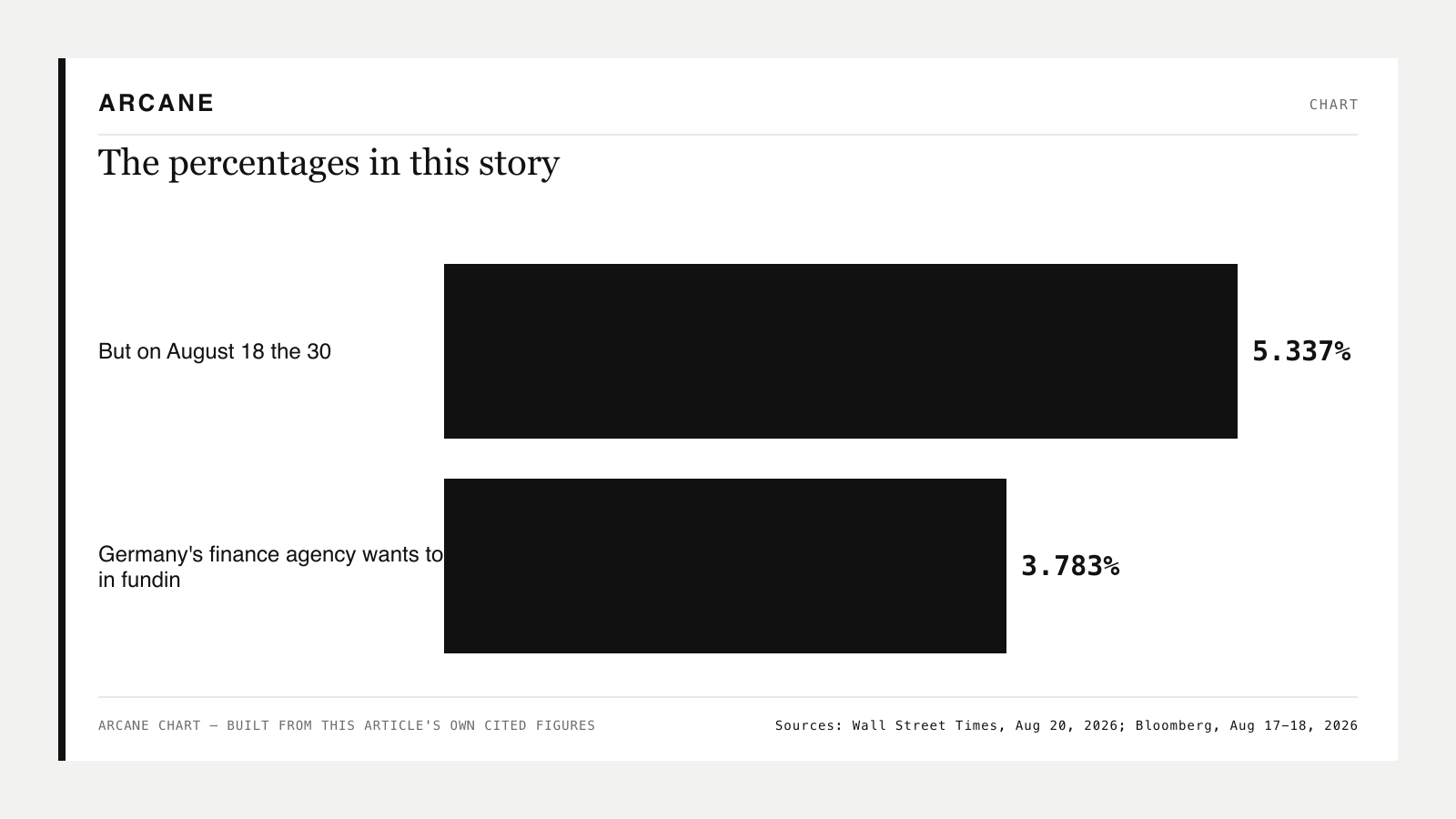
Traders spent the week easing off bets that the Federal Reserve will raise rates again, because American growth data kept coming in soft. Softer growth should pull bond yields down. But on August 18 the 30-year Treasury yield touched 5.337%, its highest since 2007, as the Wall Street Times reported on August 20.
A bond market that climbs on bad growth news has stopped pricing the economy and started pricing the borrower. This week the borrower being repriced is the United States government.
Europe is the echo chamber, and the sound it echoes back is getting louder.
Germany's 10-year Bund yield reached 3.255% on August 18, its highest since May 2011, the month the eurozone debt crisis began, Reuters reported that day. France's 10-year yield hit 4.118%, the highest since November 2008, pushing the French-German spread to 86 basis points, its widest since October 2025. Germany, the continent's most creditworthy state, now pays more to borrow for a decade than at any point in fifteen years, in a currency area where inflation was, until recently, the ECB's problem to suppress rather than endure.
The trigger this week was oil. Fading hopes for a quick end to the Iran war pushed crude higher, and with it the fear that energy costs keep inflation elevated on both sides of the Atlantic, Reuters reported on August 18. Traders now expect the European Central Bank may have to raise rates rather than cut them, a full reversal of the 2025 script, Economic Times and Reuters reported on August 18.
A war premium on oil explains a few weeks of yield. But it does not explain why long-dated yields across the US, Germany, France, Japan and Britain hit multi-decade highs simultaneously, as the Wall Street Times noted on August 20. Simultaneity is the fingerprint of one common cause: the price of lending to governments that borrow like there is no tomorrow.
Three faces
First, spending: investor angst over surging US government expenditure and a flood of long-dated bond sales drove the 30-year to its 2007 high, Bloomberg reported on August 17.
Second, the term premium. The extra yield lenders demand simply to lock up money for decades approached its highest level in twelve years this week, Mezha and term premium trackers reported in August 2026.
Third comes doubt about the Fed itself, where fiscal concerns and questions about the central bank's independence sent US yields to long-term highs, FXStreet reported on August 18.
A bond market that wonders whether the Fed will do the unpopular thing charges for the wonder. That charge travels. Global long bonds trade off each other because the same insurers, pension funds and central-bank reserves hold them all.
Scott Bessent's Treasury wants long yields down without asking the Fed for help. On August 19 it doubled the cap on its liquidity buybacks for long bonds from $2 billion to $4 billion per operation, effective September 9, and the Wall Street Times covered the move on August 20. Yields fell nearly 10 basis points on the announcement, to around 5.187%, then the pressure resumed.
The ECB wants to fight oil-driven inflation without cracking the indebted south of its currency union, and its own officials split publicly on whether to hike, coinalertnews reported in its ECB coverage on August 19. Germany's finance agency wants to lock in funding while buyers exist, so on August 18 it sold €4 billion of bonds maturing in 2056 at a yield of 3.783%, Bloomberg reported, the highest Germany has paid for thirty-year money since 2011. Each actor is behaving rationally. Together they are bidding up the global price of time.
The slow pressure underneath the war headline is arithmetic. Governments on both sides of the Atlantic ran deficits through the good years and now face defense budgets climbing because of the same war that lifted oil. Investors expect higher military spending across Europe to cushion the energy shock, on top of already-stretched public finances, Reuters reported on August 18. A bond market does not wait for the budget to pass. It reprices the moment the direction becomes obvious, which is why the selling concentrated in the long end, where the promises live.
Britain in 2022
Britain in the autumn of 2022 is one clean comparison. Liz Truss's government announced unfunded tax cuts, gilt yields spiked within days, and pension funds running liability-driven investment strategies faced margin calls that forced them to sell into a falling market until the Bank of England stepped in to buy the bonds it was simultaneously tightening elsewhere. The lesson is that long-bond repricing is not gradual; it turns into a cliff when borrowed holders meet falling prices.
What is different now is that no single government made a mistake. This is a slow, synchronized repricing of all Western sovereign debt, which means there is no policy announcement that can reverse it, and no obvious rescue buyer except the issuers themselves. The counterexample argues the other way: 2011, when the eurozone crisis blew spreads wide on genuinely local fiscal failures, and the US long bond rallied as a haven. If America were still the safe asset, European yields would be rising against falling Treasury yields. The opposite is happening.
Homeowners pay first
French and German homeowners with variable-rate mortgages pay first. Bank funding costs track these yields.
European governments pay next. Every 50 basis points on the long end is billions more in annual interest rolled into future budgets, money that comes from taxpayers or out of spending. Pension funds and insurers holding long bonds on the way down absorb mark-to-market losses, the 2022 gilt mechanism waiting in the wings.
Who profits. Holders of short-dated bills and floating-rate paper, who now earn near-cycle-high yields without duration risk, and the primary dealers who sell aged bonds back to the US Treasury through the enlarged buyback window, as the Wall Street Times also reported on August 20.
If this read is right, the Treasury's buybacks slow the bleed but do not reverse it. The 30-year yield retests and breaks 5.337% within weeks. The French-German spread widens past 90 basis points as France's budget season exposes the deficit, Reuters reported on August 18 for the current 86. The read breaks if a credible Middle East settlement collapses oil, followed by long yields falling even as stocks rally. That would prove the whole move was a war premium, and the American problem was a costume the crisis was wearing.
For thirty years American bond markets set the price of money for the world while Europe followed. This month Europe is following America into a problem America made, and there is no safe asset left to hide in, only shorter ones.