Hormuz traffic collapses while junk-bond spreads remain near five-year lows
Shipping data show the oil chokepoint nearly idle even as US corporate debt investors demand little extra compensation for default risk.
Seven ships in a day passed through the Strait of Hormuz on Thursday, sharply down from roughly 130 a day before the war began on February 28, according to Kpler data cited by Reuters on August 20.
Al Jazeera noted on August 20 that a fifth of the world's oil and LNG normally moves through Hormuz, but this week nearly all of it stopped.
In financial markets, the ICE BofA US High Yield OAS published by Federal Reserve FRED on August 20 showed that investors demanded just 2.75 percent extra that week to hold junk-rated American corporate debt over Treasuries, close to a five-year low. One market sees the strait shutting; the other is pricing as if nothing has changed. Both stances cannot last the winter.
Donald Trump announced an "Economic D-Day" campaign against Iran on August 19, vowing what he called the most crushing economic operation ever mounted, as reported by Al Jazeera on August 19 and by Reuters via Newsmax on August 21. Treasury Secretary Scott Bessent is set to detail the plan in a Monday press conference. On August 19, Iran's foreign minister Abbas Araghchi responded that America's true crisis is its own debt and surging interest costs, Al Jazeera reported.
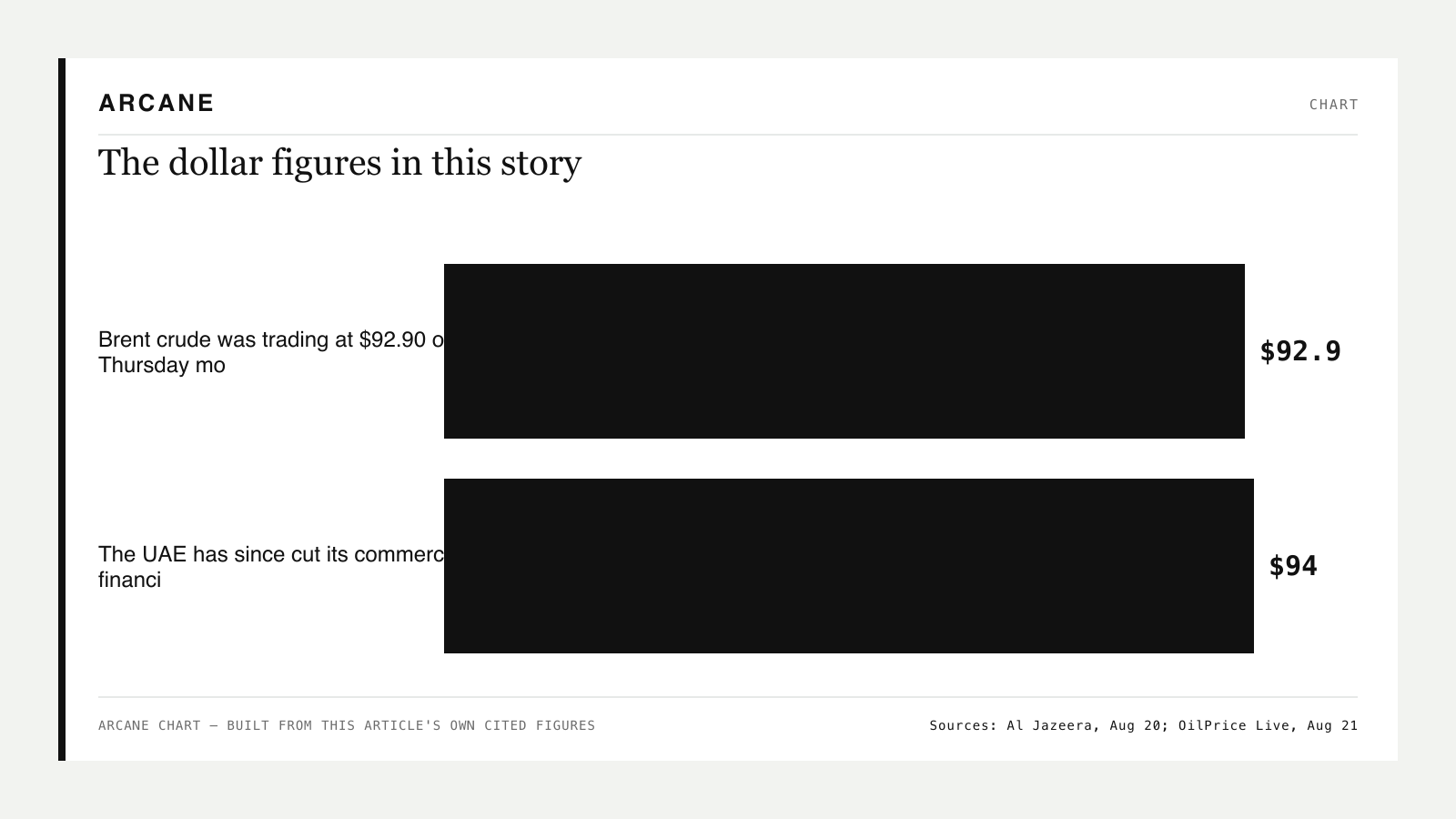
Brent crude was trading at $92.90 on Thursday morning, up from below $70 after an April ceasefire and a brief June memorandum of understanding, Al Jazeera reported August 20. The UAE has since cut its commercial and financial ties with Iran, while Brent prices touched nearly $94, according to OilPrice Live on August 21.
Since February, buyers of corporate debt have met every escalation as a signal to wait, not to charge more for risk. When American and Israeli strikes triggered the war, high-yield spreads widened to about 3.46 percent at the end of March, according to FRED's BAMLH0A0HYM2 series as of March 30.
After the ceasefire and June MoU, spreads fell quickly through 2.80 percent to reach 2.67 percent on August 14 — nearly touching the post-2021 low of 2.59 percent, per the same BAMLH0A0HYM2 series dated August 14. Each new round of fighting has brought a weaker credit response. That pattern is called habituation.
Bond fund managers are paid to stay invested and have seen inflows increase for months. A 2.7 percent spread pays them just three-tenths of a point above Treasuries for default risk, FRED data showed on August 20. Some are beginning to pull back. According to Bloomberg's Credit Edge on August 20, BMO has been cutting its junk-debt holdings, with its credit team saying investors are not being compensated for the risks (Bloomberg, Aug 20).
Habituation
The Treasury has focused on lowering long-term borrowing costs as the national debt topped $40 trillion, doubling repurchases of long-dated bonds this month to help drive costs down. The Economist reported on August 20 that this strategy means cheap credit is partly manufactured, and the authority to do so sits on Constitution Avenue.
Mainstream tanker owners are avoiding the highest-risk Middle East routes, leaving Chinese buyers to chase secure cargoes, and rates for very large crude carriers have surged into one of the year's steepest spikes, Ship Universe reported on August 20. Before the conflict, insurance for a Hormuz transit cost about an eighth of a percent of hull value; after the initial strikes it ran two to four times higher, and war-risk premiums have since multiplied further for owners still sailing, Wikipedia summarized from underwriting reports in August 2026.
Freight is where the conflict hits first, followed by diesel prices, and eventually — as borrowing costs rise for airlines, retailers and any company dependent on oil — the impact reaches the bond market. Investors are treating today’s stable credit spreads, the last domino, as proof the table is steady.
Sell fear before the shooting
During the Iraq war buildup from 2002 to early 2003, high-yield spreads widened sharply and peaked just as bombs fell in March 2003, then collapsed into a rally when the war proved cheap for markets and the recession was already priced in. Traders who lived it follow the rule: sell fear before shooting starts and buy as the war begins.
Similarly, the 1973 Arab-Israeli war was widely seen as brief and manageable, but the oil embargo behind it lasted months, inflation spanned the decade, and credit losses did not appear until years after headlines faded. The difference between 2003 and 1973 is whether the commodity remains blocked. This time, the blockage is counted in daily ships; Reuters put the figure at seven on August 20, citing Kpler.
Windfall prices
Asian refiners are paying premiums for non-Gulf barrels, VLCC owners willing to make the trip are earning windfall profits, and the increased freight cost soon moves into pump and diesel prices. Energy-importing junk issuers — European chemical companies, Asian airlines, and U.S. retailers with slim margins — see their costs surge even as their bond coupons remain locked in to peacetime spreads.
Defaults follow eighteen months after missiles launch, when companies that borrowed at today's tight high-yield spreads, as recorded by FRED on August 20, must refinance in a changed market. The losses land on pension savers when those bonds mature.
Gulf exporters able to ship continue to earn windfall profits, while independent tanker owners receive day rates unimaginable in January, Ship Universe reported on August 20. Washington gains leverage over Tehran’s remaining crude customers, with Iranian offers to Chinese buyers already falling hard under the blockade, Reuters reported via Newsmax on August 21. Any airline, hauler, or marginal borrower counting on oil at post-ceasefire prices now pays the war price instead, Al Jazeera noted August 20.
Maybe today’s credit market is right. If Scott Bessent’s Monday plan results in a negotiated squeeze rather than escalation — if Iranian crude flows to China in channels Washington allows and Hormuz reopens under a truce — today’s tight spreads will look prescient, as they did after April 2003. The war premium remains low because traders still believe diplomacy, blockades and money will resolve this before winter. That belief can be measured, which gives it value.
If Kpler’s transit count rebounds past fifty daily ships and Brent falls through $85 while high-yield spreads remain close to their August lows, as tracked by Kpler via Reuters and FRED on August 20, the bond market called it and the desk’s concern was misplaced.
But if transit numbers remain in single digits for another fortnight while spreads hold below three percent, this is the largest unpriced supply shock since 1973, building quietly in retirement accounts.
Lenders who once believed a war was someone else’s problem learned the cost; the judgment now is whether they will again.