Ship insurers cancel Red Sea war risk cover after reinsurers exit the market
The International Group of P&I Clubs maintains core mutual protections as commercial reinsurers stop backing ancillary war risk products for shipping in the Red Sea.
Gard and Skuld told shipowners on August 13 that war risks cover for the southern Red Sea, the Gulf of Aden and part of the western Indian Ocean would be cancelled from midnight on August 16, according to Royal Gazette on august 13.
Within days, UK P&I, London P&I and NorthStandard had made similar moves, with Steamship Mutual last to cancel, according to Ship & Bunker on august 13. The underlying cause was a wave of cancellation notices from the global reinsurance market, unwilling to keep the exposure any longer. The same fortnight, Suez Canal traffic hit a two-year high, nearly 1,090 transits in four weeks. Lloyd's List Intelligence reported on August 20 that Maersk says more than 30% of its Asia-Europe cargoes diverted around the Cape are now back in Suez. Container lines are returning to a corridor just as its insurance safety net vanishes.
Ships are able to transit because a single entity stepped in to take the risk that reinsurers rejected. The International Group of P&I Clubs—a consortium of thirteen mutual associations owned by shipowners—insures most of the world’s ocean fleet for liability. Each club covers the first $10 million of a claim; losses above that are pooled among the thirteen; sums above $100 million are insured commercially up to $2.35 billion and then by a $1 billion mutual overspill from the clubs themselves (International Group of P&I Clubs press release, Dec 17 2025). That overspill is drawn only when all commercial capacity is gone.
The cancelled covers this month were not the pooled mutual tower, but ancillary products—mainly fixed-premium charterers' liability with war risk extensions—sold separately and backed by standalone commercial reinsurance, according to Royal Gazette on august 13. The core mutual protections were untouched.
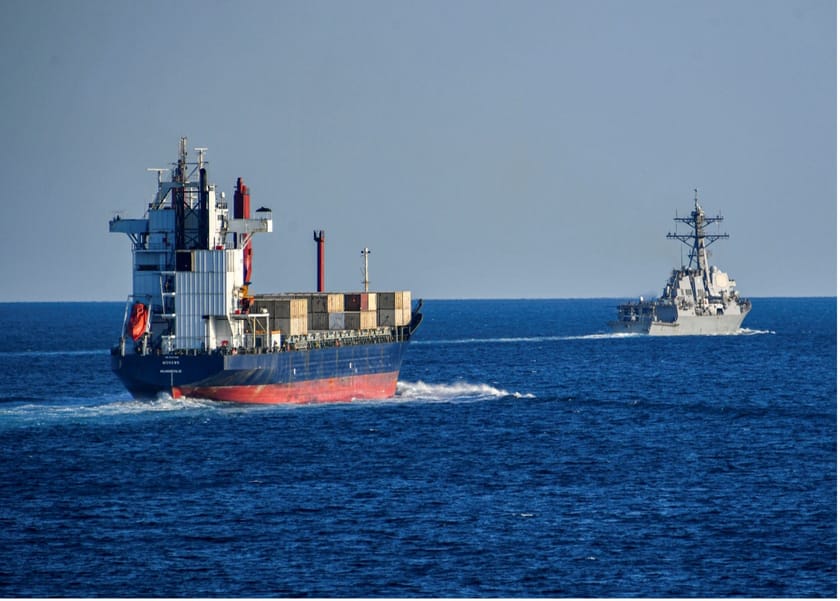
The clubs responded as mutuals do: issuing buybacks, restoring cancelled protection case by case rather than hiking prices for all, according to Lloyd's List Intelligence on august 20. The group is insuring its own members for risks that the outside market passed on.
Terms in those buybacks now draw a new map of insurability. Saudi-owned, operated and flagged ships are excluded under new charterers' coverage, while vessels with no Saudi link can still get cover, according to Lloyd's List Intelligence on august 20. Reuters reported on July 20 that the Houthis had declared a blockade of Saudi Arabia, and that Riyadh's Red Sea ports at Yanbu and Jeddah are acting as a workaround for the squeeze on Hormuz. The insurance market has quietly adopted the same boundary the militaries use, pricing Saudi-flagged ships apart from all others.
The proximate cause of the exodus is the Houthi blockade and a string of recent attacks, including a drone strike on an unmanned cargo vessel near Al Mukha and two piracy hijackings near the Gulf of Aden in four days, according to Lloyd's List Intelligence on august 20. This is the second time in a year that reinsurers have left the region; the first was in March, when Gard and Skuld stopped writing Persian Gulf and Gulf of Oman cover amid the US-Israel-Iran escalation, according to Royal Gazette on august 13. Each time, coverage was pulled from higher to lower rungs of the commercial risk ladder.
The Tanker War
The closest precedent is the Tanker War in the 1980s, when Iranian and Iraqi strikes forced Lloyd’s war risk premiums so high that only American-escorted, US-flagged ships operated by Kuwait kept moving. Then as now, commercial insurers receded and a state backstop filled the gap. What is new is that now, Saudi Arabia is the one getting priced out, and Washington is not stepping in to reflag crude.
The counter-case rests on the resilience of the mutual system. Since 1974, and especially since the pooled structure was formalized in 1996, the International Group’s clubs have absorbed every crisis without government help, recently raising the top shipowner protection layer from $2.1 to $2.35 billion at the December renewal (International Group press release, Dec 17 2025). The system has never needed a direct state rescue, even in regional crises.
Follow the cash: owners of non-Saudi ships keep sailing at flat cost because the clubs absorbed the shock, with at least 252 Bab el-Mandeb transits last week—unchanged, though still under the pre-blockade pace of 296, according to Lloyd's List Intelligence on august 20.
Saudi crude now struggles with two problematic exits: Hormuz is pressured and Bab el-Mandeb is penalized or uncovered, forcing Riyadh to load at Yanbu, run without signals, and exit north through Suez, not south past Yemen, according to Lloyd's List Intelligence on august 20.
Any major uninsured Saudi tanker loss would go uncompensated—there is no reinsurance; losses fall to Saudi government accounts and the cargo buyers who presumed coverage.
Egypt’s canal revenues recover slightly as traffic returns, still down 41 percent from pre-crisis levels, according to Lloyd's List Intelligence on august 20. Owners now pay negotiated buyback rates instead of market rates. Less expensive than March’s scramble, though opaque. The pooled obligation persists—each club’s disaster is shared among all. Crude tanker owners, meanwhile, profit from longer routes, with the highest rates in two decades, according to Lloyd's List Intelligence on august 20.
What would confirm the arrangement are more buybacks into the Autumn renewal and steady Bab el-Mandeb transits with non-Saudi vessels still covered. A big uninsured hull loss that forces outright denial, or a new round of reinsurance cuts reaching into the mutual core, would break it—ending the fix because the structure relies on losses remaining absorbable.
Insurance has not vanished from the Red Sea. It has concentrated, shifting from hundreds of reinsurance firms to thirteen mutuals wagering their collective reserves that the war does not broaden.