Washington steps in as Gulf tanker rates surge amid buyer retreat
The U.S. government absorbs its own long bonds while Gulf shipowners demand combat pay, signaling investors are fleeing both debt and oil risk.
A very large crude carrier moving Omani crude to China earns more than $520,000 a day this week, a rate that only exists because shipowners will not sail the Strait of Hormuz without being paid like combatants. Lloyds List Intelligence put the number out on August 19.
Three thousand miles away, the bond market is telling the same story. Bloomberg reported on August 19 that the 30-year Treasury yield touched its highest level since 2007 before Scott Bessent's Treasury Department announced it would raise the cap on long-dated bond buybacks to at least $4 billion, knocking as much as a tenth of a percentage point off the long end in a single session. The bond and the barrel look unrelated. They are priced by the same question: who will still be standing as a buyer when this gets worse?
The long bond does not fear inflation anymore; it fears abandonment. Foreign holders have quietly stepped back, the federal debt has crossed $40 trillion, and the government has pushed most new borrowing into short-term bills that mature inside a year. The New York Times reported on August 19 that this leaves a wall of old long bonds that Treasury officials themselves must now absorb. When the marginal buyer of a Treasury is the Treasury itself, the yield is no longer a cost of money. It is a measure of doubt.
Bessent's buyback plan is an attempt to manufacture demand where the market stopped supplying it, and Wall Street's verdict was blunt.
Politico called it a drop in the bucket for a market this size on August 19.
The same doubt
The marginal barrel carries the mirror-image doubt. Iran has disrupted shipping through Hormuz since late February, after American and Israeli strikes opened the current war, and Agence France-Presse, drawing on the IEA's August 12 Oil Market Report, found the strait functioning below capacity or not at all for commercial traffic for much of the year.
Insurers, not navies, decide whether a tanker sails. FairwayETA's shipping insurance analysis of May 6 put war-risk premiums at levels that reprice single transits so steeply that owners refuse the route regardless of flag or cargo. A barrel that cannot clear the strait is a barrel sold at whatever discount moves it overland or around the Cape. Its price no longer reflects scarcity of oil. It reflects scarcity of cover.
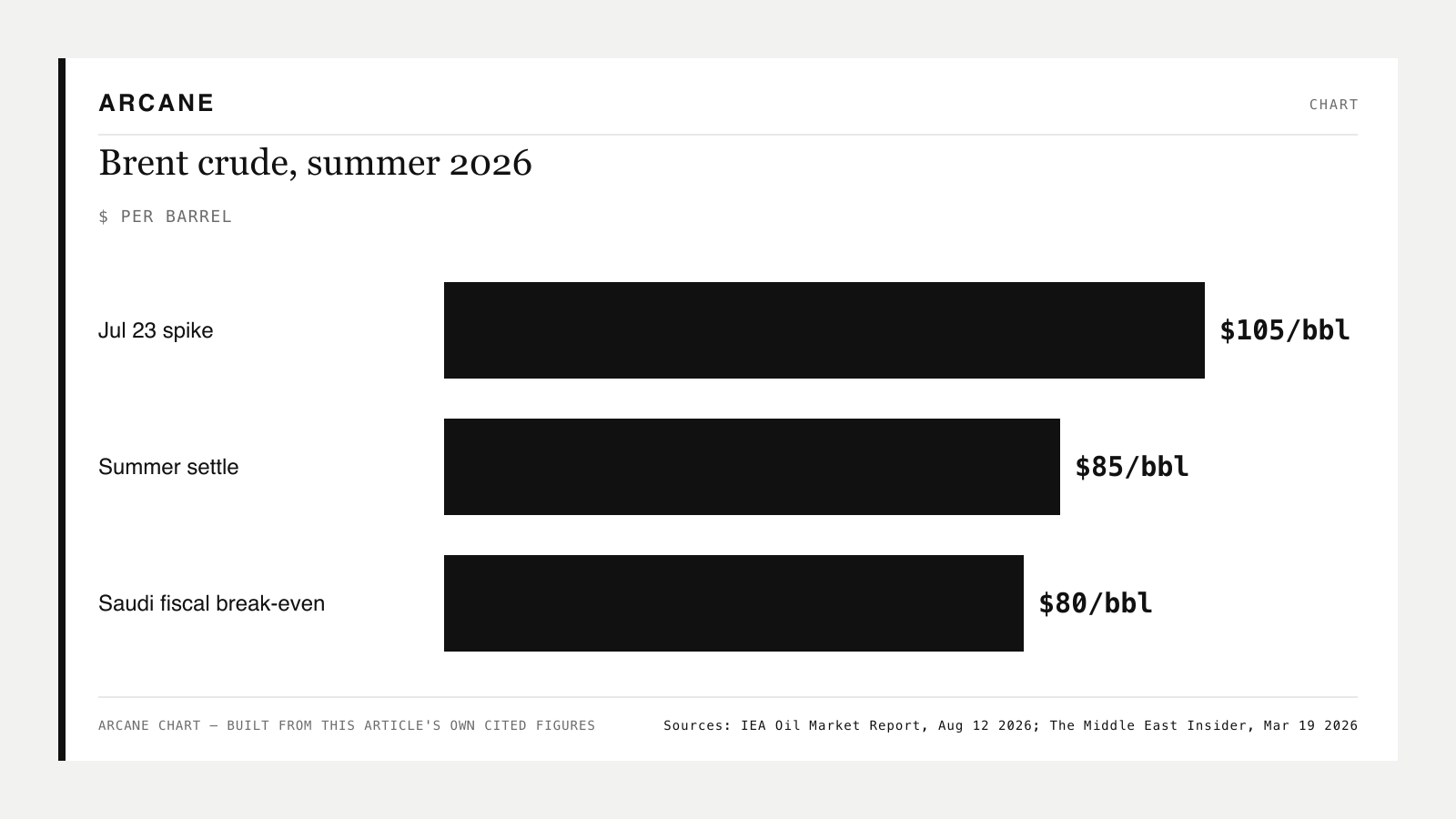
For decades the trade worked like plumbing: the Gulf exported oil, collected dollars, and parked the surplus in Treasuries, which financed America's deficits and kept the long bond bid. That loop is broken at both ends. The IEA's August 12 Oil Market Report recorded Brent swinging across a $40 range this summer, spiking to $105 on July 23 before settling back near $85, so Gulf revenue is violent rather than dependable.
Analysts told the Economic Times on March 5 that they expect sovereign wealth funds such as Saudi Arabia's Public Investment Fund to redirect capital toward domestic priorities if Hormuz disruption persists. Meanwhile Washington is fighting a naval war it must fund while asking the same bond market to absorb the bill. The exporter that used to lend America money is spending its reserves staying solvent, and America is lending itself money to keep the exporter's sea lanes open.
The trigger was Wednesday's buyback announcement and this week's rate surge, plus the latest attacks in early July when the LNG carrier Al Rekayyat and the tankers Wedyan and Cyprus Prosperity were struck in succession and Washington reimposed oil sanctions on Tehran — an account compiled from Reuters, UKMTO and CENTCOM advisories by MightyShipping on August 4. The pressure is older.
A Treasury must roll trillions into a skeptical bid, and a Gulf has watched its fiscal break-even climb toward $80 a barrel even before the war made volumes unreliable, as The Middle East Insider reported on March 19. Neither problem began this month. This month just removed the last comfortable assumption in each market.
In 1979 an oil shock in the Gulf collided with a crisis of confidence in the American bond and dollar markets, and the two fed each other until Paul Volcker chose to defend the currency with interest rates no politician would choose today. What is different this time is the direction of dependence. In 1979 the United States imported the oil and exported the credibility. Today America is close to energy-independent but its Treasury depends on foreign surpluses it can no longer count on, and its own central bank is still managing inflation rather than fighting a collapse. The lever that saved 1979 points the wrong way now.
The wrong lever
The counter-example argues the rescue works. In the autumn of 2022, British gilt yields spiraled after the Truss government's mini-budget and the Bank of England's emergency purchases ended the spiral within days, restoring order without permanent damage. If the Bank could stop a rich country's bond rout in a week, Bessent's buybacks might stop this one too.
But the comparison flatters the Treasury. The Bank of England was intervening against private sellers while keeping its inflation-fighting reputation intact, whereas the US Treasury is the issuer attempting to support its own product while the deficit widens and a war adds to it. An underwriter buying its paper is a different animal from a referee stepping into a panic.
First, the American mortgage borrower pays, because 30-year home loans price off the long bond, and a five percent handle on Treasuries means seven percent handles on houses. Second, Asian manufacturers pay, because every notch higher on the long bond strengthens the dollar, which is why Tokyo joined Washington in a joint intervention this month to lift a yen that had fallen to its weakest in roughly four decades — Politico carried that account on August 19. Third, the Gulf's own populations pay, because subsidies and megaprojects were budgeted on oil revenue that now arrives discounted by war-risk freight.
Who absorbs what
The profiteers are narrower. Tanker owners earning half a million dollars a day, war-risk underwriters collecting premiums on hulls that may never sail, and traders with storage in Fujairah who bought barrels before the shooting resumed — figures Lloyds List Intelligence published on August 19.
For the reader with a brokerage account, the exposure sits in specific places rather than abstractions. Long-duration Treasury holdings carry the risk that the buyback program fails and the 30-year retests its 2007-era highs, a level PIMCO puts near 5.3 percent (PIMCO, mid-August). Energy equities split sharply between producers whose barrels reach water and refiners dependent on Gulf crude that now arrives late and expensive. And the dollar itself has become a war asset. Strong when fear rises, undermined whenever the Treasury reaches for tools that look like financing its own deficit. None of this is advice. It is the map of who absorbs what if the fear compounds.
Confirmation is simple. Watch whether the two markets move together. Money fleeing to Treasuries when danger rises is the reflex markets have trusted for forty years — if the next Hormuz attack lifts the 30-year yield instead of pushing it down, that reflex is dead and Gulf risk has become Treasury risk. What would break it is a durable Hormuz reopening paired with a successful buyback schedule that holds the 30-year below five percent for a quarter, which would mean the plumbing held and the fear was rented, not owned.
For fifty years the Gulf's surplus funded America's debt and America's navy guarded the Gulf's oil, and both sides assumed the arrangement was permanent. This week each discovered it was pricing the other's collapse.