China's half-million-a-day Gulf rates are pulling VLCCs away from Atlantic cargoes
When a Chinese buyer will pay half a million dollars a day for one hull, every cargo from Texas to Bahia becomes the cheap alternative someone else already booked.
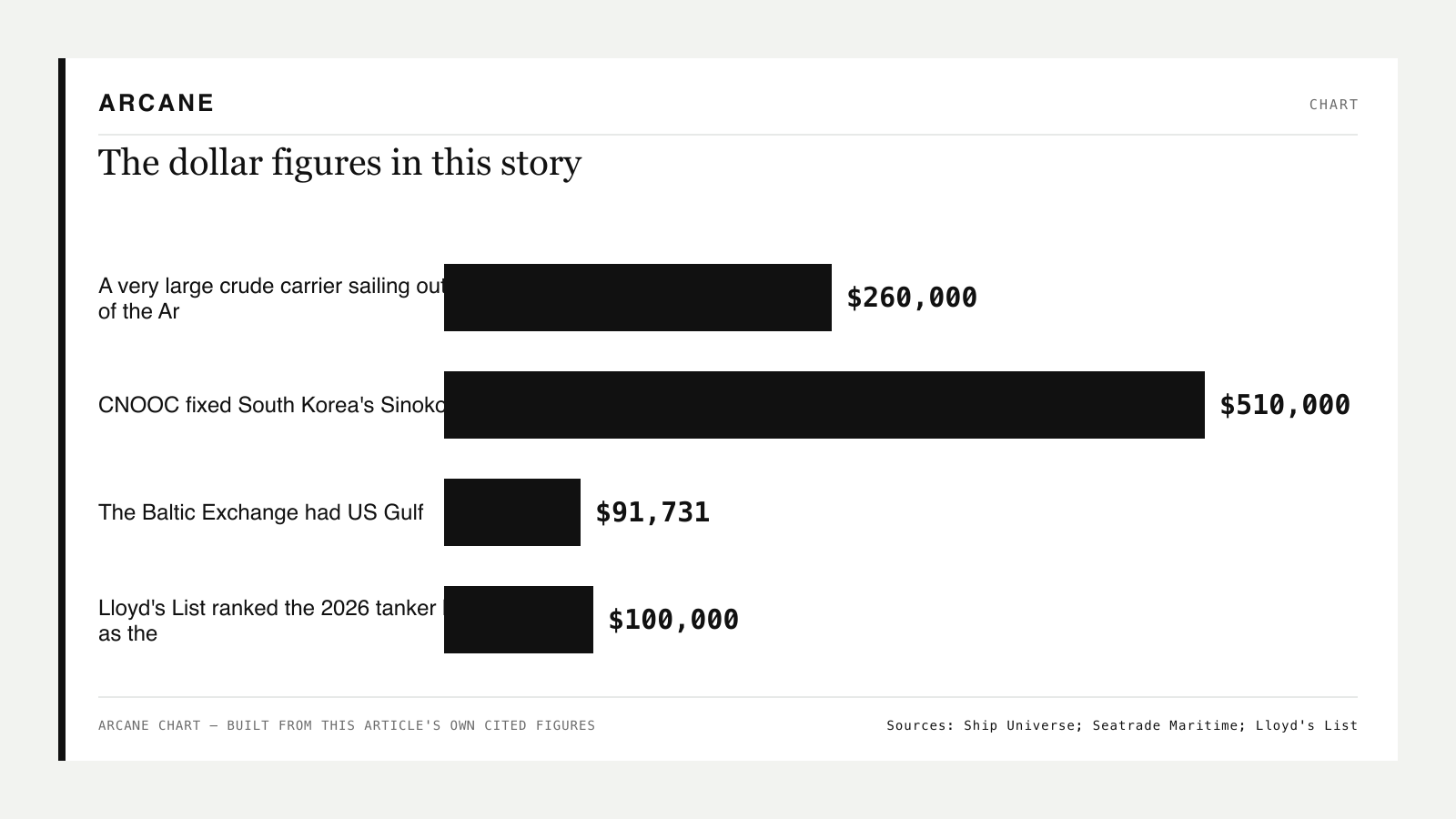
A very large crude carrier sailing out of the Arabian Gulf is earning about half a million dollars a day right now, while one loading in the US Gulf for China makes closer to $260,000 on an equivalent run, so Ship Universe reported on August 20. Both barrels go to Chinese refiners who want them and want them soon.
Hormuz is the difference, and the gap between the two basins is what moves the ships. China's state refiners, CNOOC among them, need secure liftings after months of disrupted Gulf supply, and they are paying whatever clears the market while mainstream Greek, Japanese and western-listed owners want the premium but fear the corridor. The stakes run through every Atlantic barrel bound east.
CNOOC fixed South Korea's Sinokor-owned Angola Prosperity at roughly $510,000 a day for an Arabian Gulf-to-China voyage through Hormuz, Seatrade Maritime reported on August 7. Traders and national oil companies outside the Gulf — American exporters, Brazilian producers, West African sellers — suddenly find their own freight bill rising because the ships are leaving them.
This month's spike in Chinese buying landed on top of a war that never fully reopened Hormuz. Since the strait effectively closed, VLCC volumes have collapsed even as each surviving voyage got longer. Lloyd's List described the result, in its 2026 crisis coverage, as unprecedented swings in both tonnes carried and distance sailed at once.
A round trip through the Gulf with ship-to-ship transfers outside it, near Fujairah and Oman, ties up a hull for weeks longer than a simple Atlantic run. More than 600,000 barrels a day were moving through such offshore transfers involving China-linked vessels across June and July alone, by Ship Universe's August 20 accounting.
The same arithmetic pulls tonnage off the Americas. A US Gulf-to-China run at $260,000 a day beats anything a Caribbean or Brazil-to-Americas trader can offer, so owners ballasting west simply do not stop in the western hemisphere.
Fresh fixtures are clearing well ahead of screen assessments, Ship Universe noted on August 20, which means the visible number on the benchmark routes understates what a charterer actually must pay today. The published indices lag badly. The Baltic Exchange had US Gulf-to-China at $91,731 per day back in late May, before this latest leg up, according to trade-press reporting carried by Lloyd's List on May 22.
Roughly 329 crude and product tankers sit immobilized in the Middle East Gulf, including 72 VLCCs, about eight percent of the world's entire supertanker fleet, trapped or idled by the war, according to Lloyd's List counts reported by GoS Shipping. The Gulf itself should be awash in idle ships, yet crews, insurers and mainstream owners will not put them through the strait. Willingness, not metal, went scarce.
In 2004, China's entry into the seaborne crude market caught the tanker orderbook empty and VLCC earnings ran hot for years while Atlantic exporters paid the bill for Asia's hunger. Slow demand growth met slow supply then. This time the constraint is risk pricing, which can evaporate overnight if Hormuz reopens — and that argues the other side of the trade.
Gulf-to-China rates have already fallen back toward WS49 in recent assessments, still above a month earlier but well off the peaks, the World Ports Organization tanker weekly reported on August 21. If transit normalizes, the Atlantic lists refill within weeks and this whole episode reads as a spike, not a regime.
US Gulf and Brazilian crude gets more expensive to deliver east just as Asian buyers bid hardest, so either the exporter cuts its netback, the Chinese buyer pays more per barrel landed, or the cargo waits.
Refineries in India and Venezuela's orbit running on short-haul medium tankers watch bigger ships abandon regional work, and smaller ships get stretched to cover the gap. The Caribbean and Latin American trades feel the pull-down too.
Shipowners who kept modern VLCCs trading openly are earning back years of lean margins in months. Lloyd's List ranked the 2026 tanker boom as the second best in history this August, with VLCC rates holding above $100,000 a day across much of the year.
The refiner buying Atlantic crude into Asia pays, and ultimately the motorist at the end of a chain where freight adds dollars per barrel to every long-haul movement — one reported Oman-to-China assessment tied to loading outside the Gulf sat near $140,000 a day, a cost that lands in the barrel price, Reuters assessment cited by Ship Universe on August 20.
Owners of young, insurable VLCCs profit, along with traders who locked freight early and the ship-to-ship transfer operators off Fujairah who turned a war into a service business.
Continued fixtures on US Gulf-to-China and Brazil-to-China runs clearing far above the published index would confirm the read, alongside Caribbean and transatlantic regional rates climbing on shrinking availability. What breaks it is a durable Hormuz transit arrangement that releases those 72 trapped VLCCs — at which point the tonnage deficit reverses fast, Atlantic rates sag, and the pull on the Americas ends not with a bang but with a ballast list.
The scarce commodity was never oil and never ships. Permission to be in the water is what defined this market, and in the end, it decided who paid and who profited.