Nasdaq loses its yearly gains as AI selling spreads
The pressure now tests whether global equity markets can absorb a fall that began in artificial intelligence stocks.
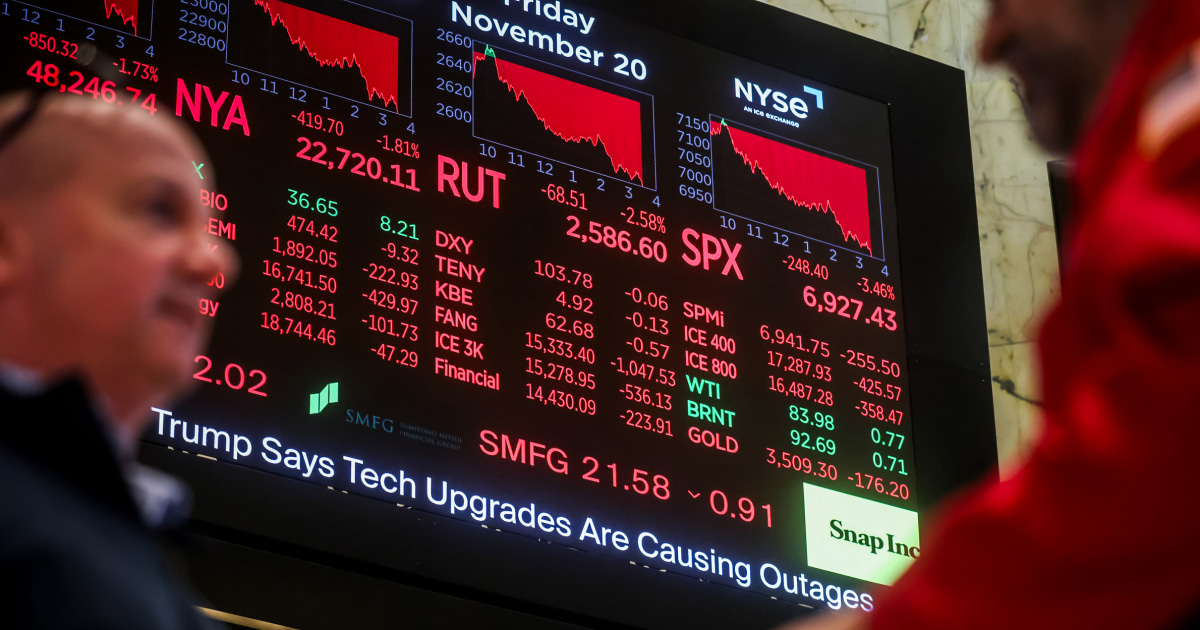
The Nasdaq Composite has lost its gains for the year. Its plunge erased those gains while the Nasdaq-100 briefly entered bear market territory, beinsure.com reported. The two index moves put the scale of Friday's decline in view without settling what comes next.
The damage now reaches beyond the most crowded artificial intelligence trade. Selling in artificial intelligence and semiconductor companies accelerated, pushing the Nasdaq Composite into negative territory for the year and sending the S&P 500 and Dow Jones Industrial Average into correction territory, beinsure.com reported. BigGo Finance reported that the S&P 500 was falling about 10% from its peak, the common line for a technical correction.
The same pressure also turned global. Rising concerns about artificial intelligence valuations, tighter monetary policy and restrictions on data center expansion accelerated selling across global equity markets, beinsure.com reported. STL.News described investors unloading technology shares, semiconductor manufacturers and artificial intelligence-related investments, sending Wall Street’s major indexes sharply lower and wiping out much of the market’s gains for the year.
Anthropic's first trading session gave the market a price for the new stock. It initially climbed to $115.10 before ending the session at $97.17, a gain of 17%, beinsure.com reported. BigGo Finance reported that the stock trades on the Nasdaq under the ticker ANT.
Published accounts disagreed on the size of the next fall, but both reported a decline. The Guardian reported that shares in the company behind the Claude chatbot fell by 9% on Friday, ceding most of their first-day gains. CryptoTicker.io reported that Anthropic shares fell 14.1 percent to $83.43 and gave back almost all of Thursday's gain.
The decline does not answer the profit question. Wall Street is increasingly questioning whether spending on advanced computing, semiconductor chips, data centers and artificial intelligence software will generate sufficient profits to justify previous stock valuations, STL.News reported. Anthropic's second-session fall does not settle whether that spending will pay off.
Rates add a second pressure point. Kevin Gordon, head of macroeconomic strategy and research at Charles Schwab, told NBC News that markets are feeling particular pressure from an increasingly “hawkish” Federal Reserve that is signaling aggressive rate hikes in the face of unrelenting inflation. Combined with a weeks-long downturn among AI and tech stocks, he told NBC News, “we have dual forces hitting the market.”
The risk-off tone did not stop at listed equities. The Economic Times reported Saturday that the global crypto market capitalisation went down 6.9% to $2.04 trillion, according to data on Coingecko. That does not prove the equity selloff caused the move, but it shows speculative assets were being marked down at the same time as technology shares.
Less on Mega-Cap Technology Stocks
There is a case that the market is rotating rather than breaking. Morgan Stanley (MS) has raised its allocation to global equities to maximum overweight and favors industrial companies, suggesting that the next phase of the market recovery may depend less on mega-cap technology stocks, beinsure.com reported. That stance concedes the weakness in the largest technology names while arguing that the equity story can move elsewhere.
The calmer reading also has support from the way corrections work. STL.News reported that a stock market correction does not automatically cause consumers to reduce expenditures. The same source reported that the stock market’s decline reflects investor expectations and uncertainty rather than proof that additional interest-rate increases are inevitable. Those points matter because they leave room for the selloff to remain a valuation reset rather than a signal of collapsing demand.
A household with a broad stock index fund feels the first branch through account balances, not necessarily through spending. If the correction stays inside market prices, the hit is financial wealth and confidence; if it spreads with tighter monetary policy, the same household can face weaker portfolio values and a higher discount rate on future income. On the reported moves, the first loss is already visible in major indexes, while the second remains a risk rather than an established outcome.
Institutions carry the sharper version of the same problem. Funds concentrated in technology shares, semiconductor manufacturers and artificial intelligence-related investments lose if the selloff keeps widening, because those were the holdings STL.News said investors unloaded. Industrial exposure gains relative appeal if Morgan Stanley is right that the next phase of recovery depends less on mega-cap technology stocks. The weak link is whether money leaving AI shares finds another equity home or leaves equities altogether.
The next run of market closes is the test. Continued losses beyond artificial intelligence and semiconductor shares would confirm a broader repricing; a rebound that restores the Nasdaq Composite while corrections ease in the broader indexes would weaken it.
What would change it. A rebound that restores the Nasdaq Composite's yearly gain while the S&P 500 and Dow Jones Industrial Average leave correction territory would break it.
Sources
beinsure.com Nov. 20Guardian Nov. 20NBC News Nov. 20CryptoTicker.io Nov. 20BigGo Finance Nov. 20stl.news Nov. 20The Economic Times Nov. 21
24 statements, each tied to its sourceWhat each statement rests onHow ARCANE checks a story