The shadow fleet's wrecks are arriving, and coastal states are holding the invoice
The ships that carry sanctioned oil were built to be unownable and uninsurable, so when they break, the bill lands on whoever owns the beach.
For seven weeks a tanker has been leaking oil onto one of the Arabian Sea's most protected coastlines, and on paper there appears to be no obligation between any responsible parties.
The Caroline Bezengi, a 2001-built Suezmax carrying an estimated 800,000 barrels of Russian crude and sailing under UK sanctions for it, grounded on a rocky outcrop near Al Qibliyah Island in the Hallaniyat archipelago off Oman on June 30. PortNews reported on August 19 that by August 15 Oman's Environment Authority had confirmed oil on roughly twelve kilometers of shoreline at Ras Madrakah, while Masirah Island was still holding clean.
A spill with a name on the cargo and no single party answerable for the coast is not a gap in the system. It is the system working as built.
The ship itself is a portrait of the shadow fleet's design. PortNews reported on August 19 that its registered owner is Rentoor Shipmanagement Ltd, which appears to be based in China; its commercial and safety manager is China-based Villar Shipmanagement Ltd; and its last flag, Cameroon, dropped it in June.
It had loaded at Novorossiysk and transited the Suez Canal at the end of May, and its crew first reported trouble off Mukalla, Yemen, on June 8, three weeks before it went onto the rocks. The cause of the grounding has not been established.

The salvage fights the monsoon
So the cleanup falls to people who never touched the oil. Ambrey, a British maritime response company, Oil Spill Response Limited, and Omani firm OMAN PESCO are on site with salvage vessels, aircraft and more than 100 tonnes of equipment; specialists boarded the wreck with support from the Royal Air Force of Oman, PortNews reported on August 19.
Dimitris Maniatis, chief executive of the salvage outfit involved, told Bloomberg the operation could cost between $200 million and $500 million (Bloomberg via Yahoo Finance, Aug 17).
The salvage itself is fighting the calendar. The Khareef monsoon is running, with winds near 40 knots and waves around four meters, while the tanker lists about 17 degrees and lacks reliable power, delaying any cargo transfer. Teams are weighing moving oil into intact tanks before lightering the rest to another vessel, PortNews reported on August 19.
Meanwhile the region is producing wrecks faster than it produces answers. The Minoan Pioneer was hit by a projectile near Khasab on August 3 while transiting the Strait of Hormuz, with one seafarer missing, in what maritime security sources called a suspected Iranian attack, the Jerusalem Post reported in August 2026. An ADNOC tanker was struck in the strait on August 8, according to the UAE, as Windward reported on August 12. Two slicks now sit in the same water, Al-Monitor noted in August 2026.
Ships without real cover
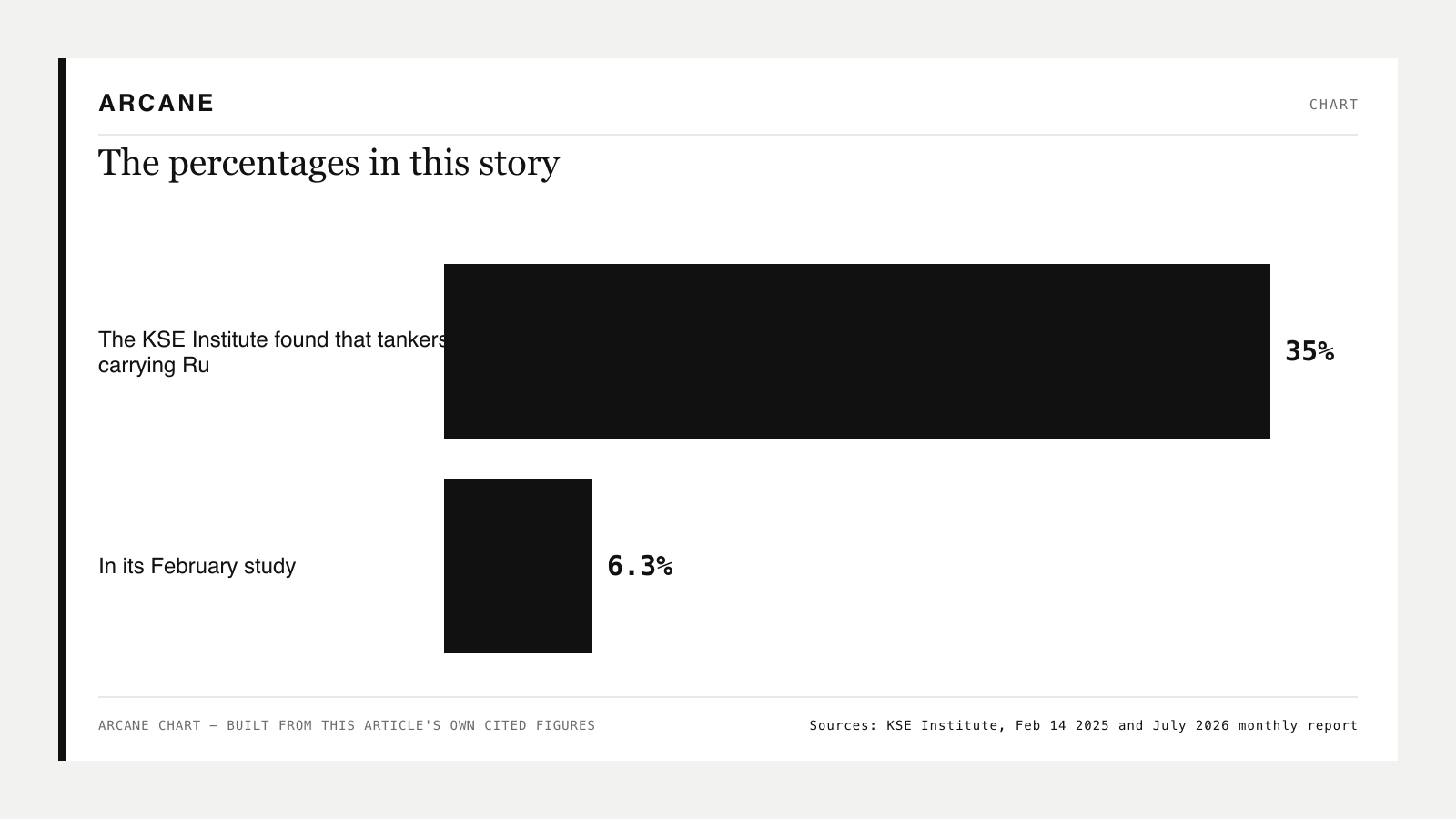
Russia's export system runs on ships the Western insurance system will not touch. The KSE Institute found that tankers carrying Russian crude shipped only 35 percent of volumes under International Group protection-and-indemnity cover this July, and that 94 percent of the loaded shadow-fleet tankers leaving Russian ports or doing ship-to-ship transfers were older than fifteen years, according to its monthly report for July 2026.
In its February study, KSE found identifiable P&I coverage for just 6.3 percent of the world's 4,539 tankers with no ties to price-cap countries (KSE Institute, Feb 14, 2025).
Moscow wants oil revenue flowing and treats wreck risk as someone else's line item; the ship managers collect fees from ownership structures designed to dissolve on contact with a lawsuit. Coastal states like Oman want their reefs intact but cannot close the shipping lanes their own LNG and container trade depends on. Western sanctioning authorities want pressure on Russian exports without owning the environmental fallout.
And insurers have spent more than a year warning publicly that hundreds of tankers operate without proper cover or maintenance, as Skuld's chief executive Ståle Hansen told S&P Global Commodity Insights in July 2025. Everyone's incentive points toward the same outcome: the risk sits unpriced until a hull breaks.
Cornwall and Galicia
When the Torrey Canyon broke up off Cornwall in 1967 with no adequate liability regime behind it, Britain ended up bombing its own coastline's wreck to burn off the oil and absorbed the damage itself; the scandal produced the international civil-liability and fund conventions that followed. A coastal state learned there that jurisdiction over your waters is not the same as solvency against the ship in them.
Galicia ran the experiment in reverse. When the Prestige sank off Spain in 2002, the vessel sat inside the proper insurance and fund architecture, however slowly, and Spanish claimants eventually recovered through the international regime. The difference between Cornwall 1967 and Galicia 2002 is exactly the difference Oman faces now: the Caroline Bezengi sits outside every fund those conventions built.
Who pays for Ras Madrakah
First, Oman pays, borrows, or bills whoever it can find, and its fisheries and Dhofar tourism absorb losses that will take years to show up in accounts. Then every coastal state from Djibouti to India looks at Ras Madrakah and starts writing rules, port-entry vetting, mandatory insurance proofs, detention powers, aimed at ships without real cover, which raises the shadow fleet's operating costs at exactly the moment sanctions enforcement is already tightening. Russian crude then moves onto older, cheaper, even less insured tonnage to preserve margins, raising the probability of the next Caroline Bezengi. The system selects for the ships most likely to fail, then acts surprised when they do.
The salvors and spill responders profit, for one: Ambrey, OSRL and firms like Maniatis's are booked solid, and the International Salvage Union membership earns on other people's wrecks. Legitimate tanker owners profit too, quietly, because every uninsured hull that leaks pushes regulators and charterers toward verified-cover vessels, widening the premium for compliant capacity. The losers are legible: Oman's Environment Authority, the fishing communities along the Dhofar coast, and the Hallaniyat marine reserve, which took decades to accumulate what is now washing ashore.
Oman could still be made whole anyway, through a diplomatic settlement with Moscow, a court piercing the Rentoor or Villar structures, or an ad hoc Gulf-state fund. If salvage and cleanup invoices start being paid by anyone connected to the ship's beneficial owners within eighteen months, the "coastal states hold the invoice" framing fails, and the shadow fleet remains merely ugly rather than structurally uninsured.
Another aged, thinly insured tanker grounding or breaking in a crowded lane, followed by a coastal ministry rather than a P&I club commissioning the response, would establish the pattern as policy-relevant fact rather than one bad June. Gulf Today reported on August 13 that the IMO is closely monitoring the leakage.
Sanctions policy outsourced its enforcement to the sea, and the sea is returning the work unfinished, with an invoice attached. Until wreck liability follows cargo instead of shell companies, every coastal nation from Muscat to Mumbai is underwriting Russia's oil discount with its own shoreline.